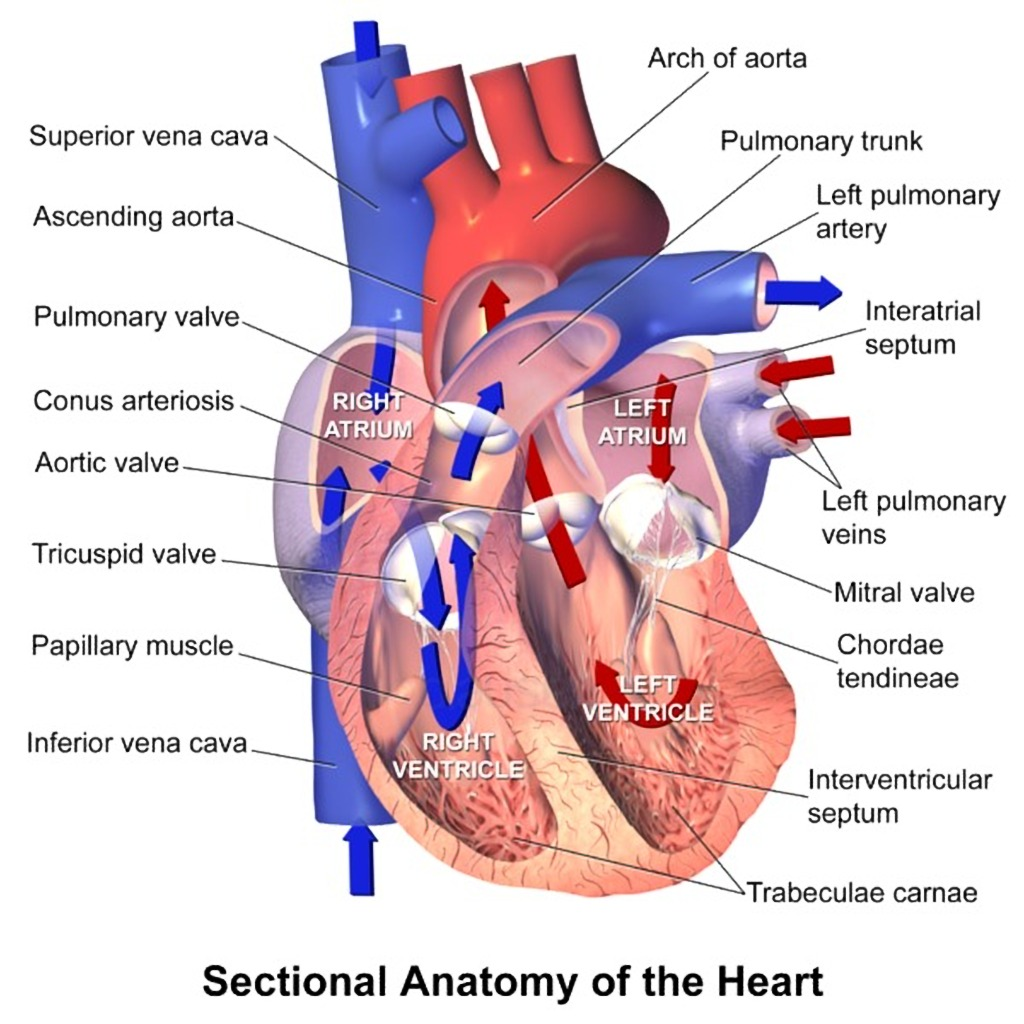
The heart consists of four chambers. Each of these chambers are connected so that our blood can circulate throughout our body. Let us begin by tracing the flow of blood through the heart. Deoxygenated blood enters the right atrium via the superior and inferior vena cava. Afterwards, the right atrium contracts and blood is shunted through the atrioventricular valve into the right ventricle. Now the blood must travel from the right ventricle to through the pulmonic semi lunar valve into the pulmonary artery where the blood then becomes oxygenated within the lungs. The newly oxygenated blood then travels back to the heart through the pulmonary vein which opens into the left atrium. Upon entering the left atrium the blood then travels through the left atrioventricular valve emptying into the left ventricle. It is within the left ventricle that the ventricles give one final push and eject the blood through the aortic semi lunar valve into the aorta from where the blood is distributed throughout our body. Seems fairly simple, right? Well perhaps, but as we look closer into the heart itself we begin to see how things start to become more complex.
Let’s look a the heart.
Tracing the blood flow is as follows;
1. Blood enters the superior and inferior vena cava and flows into the right atrium
2. The right atrium contracts and the blood flows through the right atrioventriular valve or also called the (Tricuspid Valve) into the right ventricle.
3. Next the right ventricle contracts and blood flows through the pulmonic valve into the pulmonary artery and travels to the lungs where the blood picks up oxygen.
4. Now the oxygenated blood flows back to the heart via the pulmonary vein into the left atrium.
5. The left atrium contracts and freshly oxygenated blood flows through the left atrioventricular valve, or also called the (bicuspid valve) into the left ventricle.
6. The left ventricle contracts and pushes the fresh blood through the aortic semi lunar valve or the aortic valve into the aorta through the rest of the body.